h1

Aquaponics update ……

May 24, 2012

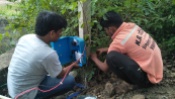
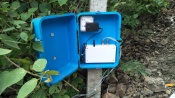
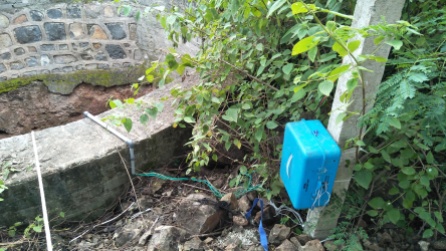
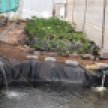
Our aquaponics system, which is almost 65 days old now &  has already started giving handful of vegetables for daily use. These are aquaponically produced completely organic and healthy veggies which are almost free of cost (if cost of the system (Fixed) is not considered). We have planted Tomato’s, okra, Egg plants, Spinach, Fenugreek, chilies and better gourd plants. All of them are either in yielding stage or on flowering. We have harvested around 1.5 to 2 Kg of Spinach with every 7 – 10 day repeat harvesting and 0.5 kg of fenugreek, 200 gm green tomatoes, and 300 gm of fresh Okra, whereas chili / bell paper and cabbage are in raw to harvest within 15 days. . In all as earlier estimated, we can harvest at least 2 vegetable / week for 4 member family size.

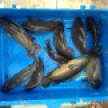
Two fish tanks (tank A & B 500 lit each) with around 200 to 250 fingerlings of Cyprus fish (5 to 7 cm) are doing quite well now (with growth of around 2 cm in 40 days). In last week because of over feeding and improper oxygen pump, DO drop down to below 1 ppm caused heavy fish mortality (80 to 100 fingerlings died in 2-3 days span). Now one submersible pump is fixed in tank (A), which pumps water to, 2 PVC pipes (3” dia) with hole for hydroponics plantation (around 12 ft length). Then water back to fish tanks (B) with increased DO. As water flow in pipes, DO in fish tank increases to more than 3 ppm (on an average) in span of 2 hr of motor run.

One more thing, we are observing that as plant density in grow beds increases, plant health and production goes on increasing. This is may be because of nutrient balance occurred naturally with plant density. Periodical testing of soil and water for nutrient content will be done in next few days to understand relation between root density Vs water quality.

Few design problems are also noted, while operating system, which will be documented separately and uploaded soon.

h1

Kitchen Waste Biogas Unit ………….

April 10, 2012

Kitchen waste can be utilized for production of Biogas (daily waste of 4 member family – aprox 500gm). In existing designs of biogas (developed by different NGO/agencies) their are few problem and one of major problem is that most of them are bulky units. To check feasibility of making tiny domestic Kitchen waste biogas unit project is started at Vigyan ashram, Pabal. Mr. Sandesh Mhadalekar ( Agril Btech Student , Dapoli Agri Btech college) worked on this project in last 3 months and concluded following results as-

Objectives of the project:-

  • To develop low cost biogas until suitable for small family (4 members) kitchen waste.
  • To utilize kitchen waste for its maximum biogas production capacity.
  • To recycle kitchen waste by treating it in biogas unit so as reduce pollution.

Considerations:-

  • Small family of 4 members on an average produces 500 gm kitchen waste per day.
  • Biogas unit should be very handle (small in size) which probably fit into kitchen.
  • It should produce any of odours.
  • It should be low maintenance biogas unit.

Considering above objectives and considerations we found that developing fixed dome type biogas unit will be more suitable for our study.
Biogas unit construction details - 

PVC pipe of 20 cm diameter & 127 cm length was taken and 2 holes of 2.5 cm diameter are made on at 30 cm from top of this pipe as shown in fig. 3.1.1 The holes are apposite to each other. One of them was used as inlet and other used as outlet. The inlet pipe was 90 cm long inside the PVC pipe (dia. 20 cm) and reducer was fitted to the inlet pipe from the outside. Connected the PVC pipe (dia. 5 cm) has length 15 cm. After that the ‘T’ joint was connected to pipe for the placement of mirchi cutter and 10 cm of PVC pipe connected to the ‘T’ joint also connected the end cap to the PVC pipe as shown in fig. 3.1.2.

On the end cap the hole was made for the handle of the screw conveyor. The 1.2 cm diameter of MS rod was taken for screw conveyor. The metal sheet was taken for made the disk of screw conveyor. The metal sheet was cutted in circular shape has dia. 2.4 cm. Make the hole at the centre of disk and cut it as shown in fig.3.2.1. The circular disk was bended as shown in fig.3.2.2. All circular disks are welded on the MS rod as shown in fig. 3.2.2. Screw conveyor was fitted in the PVC pipe (dia. 5 cm) and fitted the end cap.

PVC pipe was fitted in the hole has diameter 2.5 cm. Holes was made to the both end-caps (dia.20 cm) has diameter 2.5 cm, one for gas outlet and other for flush value for flush the total biogas system.

DIAGRAM ATTACHED BELOW SEPARATELY.

Results of project so far- 

Gas produced agents feed input and burner run time is recorded.

The gas burn with blue flame for 6 to 8 min. in the 24 hrs after adding the feed in the biogas.

Following table shows relation input Vs gas produced -

Sr. No.

Date

Feed for biogas

(gm)

Weight of material for drying (gm)

Weight of dried material (gm)

Volume of gas produced (cm3)

pH

21/02/2012

400

100

22

10303.41

7.0

22/02/2012

700

300

51

8765.31

7.0

23/02/2012

610

200

38

22815.24

7.0

24/02/2012

480

200

42

18427.13

7.0

25/02/2012

500

100

19

20163.57

7.0

26/02/2012

700

200

33

22407.39

7.0

Gas produced Vs Burner run time shown below -

Sr. No.

Date

Burning time (min.)

Quality of flame

1

29/03/2012

2

Blue

2

31/03/2012

8

Blue

3

04/04/2012

3

Blue

4

05/04/2012

5

Blue

5

06/04/2012

7

Blue

6

07/04/2012

6

Blue

7

08/04/2012

9

Blue

Diagram of Biogas Unit -

h1

Aquaponics experiment status in Vigyan ashram….

April 5, 2012

Aquaponics Project Update till March 2012.

For studding possibilities of Aquaponics systems under Indian scenario initial trial experiments are going on in Vigyan ashram from July 2011.  During last 7-8 month, we were testing its basic working principles, different fish and plant growing parameters, water / growing media qualities and possibilities of developing entrepreneurship for rural as well urban/semi-urban youth. In short we try to complete same initial Home Work before entering into actual commercial field testing’s.

Following are the important work we did during last 7-8 months in this regard-

  • We established one small NFT (Nutrient film technique) based system having 500 liters water tank and 0.21 Sq M growing area with tilapia/guppy/rhoau fish.
  • In this system leafy vegetable like fenugreek / Spinach and fruit vegetables like Tomato / Okra where planted.
  • Small pump of 2.0 meter head was fixed for water circulation.
  • Apart from this we also tried to build one small system based on flood & drain system, but system failed due to very small water tank & growing area.

Following are the important learning for last 7-8 months-

  • Fish grows well in fixed range of parameters like pH, NH4/NH3 and dissolved oxygen level in water. If fish are growing well with all above parameters then Aquaponics system will work fine.
  • Following table shows water quality parameters of our system Vs water in Thitewadi Dam ( from where we brought fish)-

Date of test

Aquponics system water

VA farm Tank

Thitewadi dam water

  pH NH4 DO pH NH4 DO pH NH4 DO

01.02.2012

8.5

0.5

4.0  PPM

8.5

2

10.8

8.5

less than 0.5

6.4 PPM


  • From above table we learn that even though pH of water is same but dissolved oxygen level is much less in aquaponics system water and that is the reason for less fish growth & much higher fish mortality. (DO should be more that 5 ppm and NH4 should be always less than 0.5 PPM).
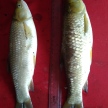
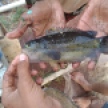
  • In case of VA farm tank even though level of oxygen is good but level of NH4 is very high which is mainly because of accumulation of fish waste (NH4) in tank. (Need to reduce by replacing water or by aquaponics).


  • Periodical water analysis of aquponics system was done do check bio-filtration process and its efficiency in relation with root (growing bed) surface area. Following table shows effect of more root surface area on level of NH4 -

Date of testing

Testing Parameters

Grow bed surface area
  NH4 NO2 NO3 DO pH  
14.01.2012 0.5 PPM 0.4 PPM 0.40 PPM 6 PPM

8.5

Growing bed SA = 0.039 Sq m
20.02.2012 0.3 PPM 0.5 PPM 0.50 PPM 6 PPM

8.5

Growing bed SA = 0.21 Sq m


  • From above table this is clear that when we increase growing bed area / root surface area bio-filtration increase, resulting in better plant/fish growth.


  • Similarly information about fish rearing (water parameters) / fish breeding / fish feed / plant growing media in aquaponics system / plant to be grown / different system consonants etc is also gathered from internet and by personal visits during these 7-8 months.

From all above learning’s new system for with commercial aspect is designed. Following are important features of this system –

  • Water tank – 1000 Lit with fingerlings (No.500) of Cyprus fish.
  •  Growing bed area 1200 Lit (half cut blue barrels).
  • Depth of Growing bed 0.30 M (Aprox).
  • Growing media – cocopit + vermicompost + sand (1:1:0.5).
  •  Plants to be grown – Leafy vegetables – Fenugreek, Spinach, Coriander. Fruit vegetables – Tomato, Chili, Capsicum, Brinjal.
  • Present water analysis report –

Water pH Remark MH3 (Ammonia level) Remark DO Remark
7.0 – 7.5 Fine 4.0 PPM More than prescribed level  (should below 1.0 PPM) 3.0 PPM Less than prescribed level (should more than 5.0 PPM)


  • Total carpet area required for system- 300 Sq Ft.
  • Expected cost of system – Rs.9000.00.
  • Expected month of regular harvesting – Veg –June / Fish – Sep.

Probable modifications / work need to be done –

  • Dissolved oxygen level need to be more than 5 PPM for proper fish growth.
  • On time Nutrient deficiency rectification for proper plant growth.
  • Checking feasibility of project on the basic of total production Vs investment.


h1

Carboon free Chikki Making business………………….

January 30, 2012

Chikki making (Indian dry nut Candy) is very profitable and well set cottage scale business in rural and urban areas. With SHG revolution many SHG’s groups and individual entrepreneurs are engaged in Chikki making. In this business fuel cost is supposed to be major input cost , which involves in roasting nuts and making sugar/jaggery syrup. If this cost is reduced by using solar cooking devices(Solar scheffler / PRINCE – 40 ), business profit can be significantly increased and new carbon free product can be marketed with extra cost (details are given in attached link below). In our trial we also found that taste (quality) of final product is also far better than fire wood / LPG stove made chikki, mainly because of even roasting of nuts.

In short these devices can be used for commercial Chikki making business. Detailed trial report is given below-              carbon-free-chikki1.

h1

Aquaponics Experiment so far …………..

December 14, 2011

As earlier posted, We have started working on Aquaponics for testing its possibilities in Indian conditions. Initial small project is going on with NFT model (Which can be called as hobby scaled setup) with Indian Carp fish Species (Catla). Presently we are facing lot of problems in fish survival and plants growth.

With this initial experiment, we have identified few area need more focus as –

  • Fish survival – We are facing problem of fish survival in tank, which is around 500 lit and of 1 ft depth. Water is of 8.5   PH and 625 Hardness. We were feeding them with ground nut oil cake of around 10 to 20 gm / day. Following are the initial observations for fish mortality as – Low oxygen level in water , improper fish feeding , less water depth, Fluctuating water temp ( because of on setting winter) , high ammonia content. Presently we don’t have any water testing kit for monitoring above parameters, so exact figures are not available.
  • Plant growth – Plant growth when compared with control treatment (plants planted in normal soil conditions), no significant growth is observed for Aquaponics plants. This is mainly because on improper growth of fish (as per references from internet documents).
  • Improper bio filters – This is been observed that water color was turning blackish and giving off smell.  It’s may be because of less root and growth media surface area for bacterial growth.

Now in new setup on the basic of above observations are designed for cultivating Lettuce crop (as its best adapted to Hydroponics system) and with same fish species. Precautions will be taken for controlling above parameters and new water testing kit will be purchased for testing NH4, NO3 and Dissolved Oxygen.

Whoever trial on decorative fish (in my home) is working fine. Initial when root surface area was less water smelling but now when plants are growing fast and developing more roots, smell is decreasing and water quality is also  improving (  by visual observations observation ) . Growth of the plants are still not as good as open soil planted plants , but vigor , health , shine on leaf is good. I read on net that it takes at least 5-6 moths to starts nitrogen cycle properly with functional bacterial colonies.   


h1

Finishing School Inaguration ceremony ……………..

December 9, 2011

On 30th of November finishing school building inaugurated in presence of Sir Kevin Smith (Chief Executive – GKN plc), Mr Douglas McIldowie ( Group HR Director, GKN plc), Mr. Hemant Nighojkar (Managing Director India),Mr.Diliprao ji Valsi-patil (Speaker Maharashtra State Legislative Assembly), Mr.Ashokrao ji Powar (MLA, Shirur-Haveli) and other delegates from political and social background.

A programme started with small film (Photo side show) on finishing construction followed by presentation by Shri.Ashok Kalbag on Vigyan ashram and its working philosophy. After that Sir.Klevin smith along with other delegated from GKN took a round of Vigyan ashram and interacted with DBRT students on their training and different project. Then in main opening ceremony hall we had certification distribution and students experience sharing function, in which DBRT students who have contributed in construction of Finishing school building received special contribution certificate from Sir.Klevin Smith.

On arrival of Shri.Dilip Valse Patil and Shri.Ashokrao Powar, Finishing school building was inaugurated by offering coconut, at the same time new Fab-lab section was also inaugurated. After that we had a main function in which Shri.Ashok kalbag gave speech on Finishing school Project and VA future plans. After  that Shri.Dilip Valse Patil inaugurated our new CD’s of Workshop Technician and Electrification basic and advance courses.

While giving inaugural speech Sir.klevin smith took overall review of GKN in context with Indian development and award own by VA. Programme ended with the speech of Shri.Dilip Valse Patil in which, he thanked GNK for supporting VA and explained importance of Practical Learning as Need of Developing India.

h1

Inaguration of Modern Food Processing facilities at Vigyan ashram , Pabal…….

December 9, 2011

On 3rd of November, Community food processing and testing unit was inaugurated officially in special presence Mr.Pramod Chaudary (Chairman Praj Industries Pvt.Ltd ). We had small function of opening ceremony in which both processing and testing unit was inaugurated by chief guest. While giving his speech Mr.Pramod Chaudary explained views of Praj Industries and Praj Foundation in Rural development and express their full support to Vigyan ashram. DBRT past student Mr.Bansilal Mandi , SHG member Sou.Sunita Jadhav and progressive farmer Mr.Ramkrushna Agarkar also express their views about new modern facilities available in community food processing unit. Before that a short film on this project was shown to all delegates and round of Vigyan ashram campus was taken to interact with DBRT students.

h1

New vermicomposting bed…………

December 8, 2011

New Vermi-composting bed-

New Vermi-composting bed made up of polyethylene worth Rs.1100.00, is donated by Mr.Sachine Desai (Samantak, Dhamapur). This bed is low cost , easy to carry and having special arrengment for Vermi-wash harvesting. Many farmers in Pabal area wanted to know cost and other benefits of this bed so we installed it in VA campus with proper compost layering’s with help of Dhamapur DBRT students as a part of Vermi-composting practical exam of DBRT.

h1

One day brain storming session on Work Centric Education …………..

December 8, 2011

One 13th of November, one day brain storming session was organized on Work Centric Education by VA & Avkash Nirmity, Pune. Role of Education, Present missing links in Educational system, Future Educational Policies, Role of VA and society were the few topics discussed in detailed. Documentaries of Vigyan ashram, Srujan Vidyalaya- Kolhapur and interview of Shri.Anil Sadgopal were also seen and discussed on the \same day. Following members were present for this session as-

1  All staff members from VA.

2 Shri.Samir Shipurkar.

3  Shri.Amitraj Deshmukh.

4 Sou.Swapnali Patil.

5 Sou.Chaya Goltgaonkar.

6 Mis.Shilpa Ballal.

7  Sou.Radhika Murty.

8  Shri.Aditya Atle.

9  Miss.Joyti Kulkarni.

h1

Pabal Dome Construction training at Architectural college INDORE …………….

October 8, 2011

Zonal National Architectural Students Association (NASA) convention 2011, was conducted at Indore Architecture college. It was national conference of all India architectural college held this year at Indore. Dome construction was one of theme for this 2 days conference. We got request from organizing commitee in August 2011.

Pabal dome construction training was given for 2 days with 8 M dome construction on site. Dr.Ashok Mathur , Mr.Anand Gosavi , Mr.Kasim Inamdar were took part as resource persons for training.  8 M dome was erected on site and then few section were plastered. 

Follow

Get every new post delivered to your Inbox.